Table of Contents
In the first 90 days, a good LLM SEO agency should move you from “we don’t know how AI talks about us” to a measured baseline, a fixed technical and entity foundation, your first answer-ready content and an honest review of what changed. That is the typical shape of a well-run start, although every brand’s timeline depends on its site, its market and how quickly decisions get made.
At AtalosWeb we have run search programs for businesses since 2017, and we find that most frustration with AI visibility work comes from unclear expectations in the first quarter. This guide breaks the 90 days into three phases, lists what you need to provide, and shows what a useful day-90 report should contain.
💡 Key Takeaways
- Expect days 1–30 to deliver a prompt-level baseline, full account access and an agreed prompt set, not a pile of new content.
- Plan for days 31–60 to focus on crawler access, entity consistency and the first answer-first pages.
- Use days 61–90 to start off-site signals such as reviews, directories and expert mentions, then review results against the baseline.
- Prepare a named internal owner, subject-matter experts and fast approvals, because client-side delays slow the first quarter more than anything else.

What an LLM SEO Agency Should Achieve in 90 Days
The goal of the first 90 days is a measured starting point and a working foundation, not a finished result. By day 90 you should know how AI assistants currently describe your brand, what has been fixed, and which signals are being built next.
LLM SEO means improving how large language models such as ChatGPT, Gemini, Claude, Perplexity and Microsoft Copilot find, understand and cite your business. It overlaps heavily with SEO, but it adds prompt tracking, entity work and a stronger focus on third-party sources. Our AI SEO and GEO agency services page explains the full method; this article focuses on the opening quarter.
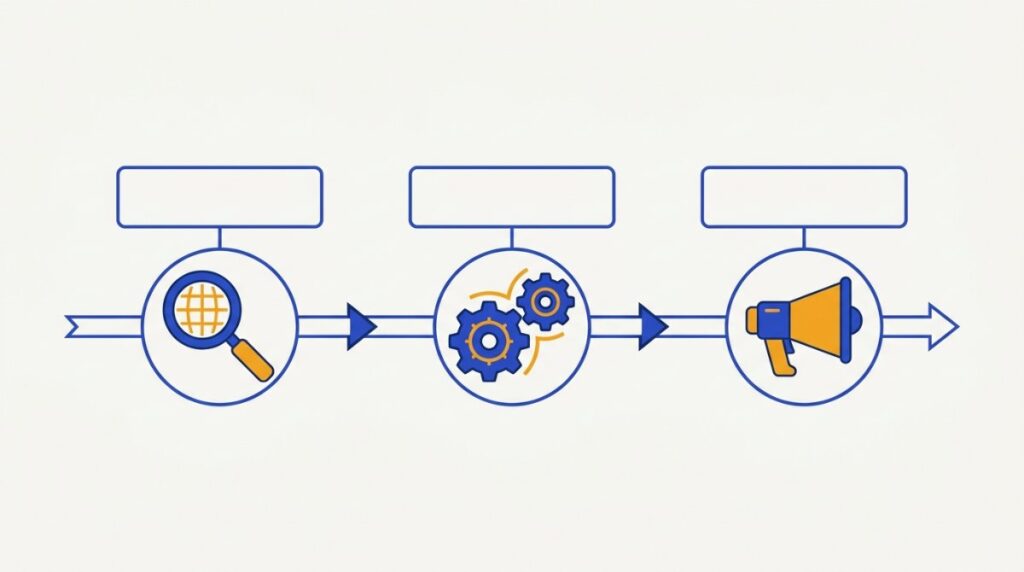
Think of the 90 days as three overlapping phases. The boundaries shift from client to client, but the order rarely does: measure first, fix second, amplify third.
Days 1–30: Discovery, Baseline and Access Setup
The first month is about access, discovery and measurement. A good agency spends it learning your business and recording where you stand in AI answers before it changes anything.
Discovery and prompt selection. Expect workshops or questionnaires about your services, best customers, sales objections and competitors. From that, the agency drafts a prompt set: the real questions buyers ask AI assistants when they are researching, comparing and choosing a provider in your category. You should review and approve this list, because every later report is measured against it.
Baseline audit. The baseline records how often your brand is mentioned, cited or recommended for each prompt, which competitors appear instead, and which sources the AI platforms rely on. Because answers vary between runs, a credible baseline samples each prompt more than once rather than relying on a single screenshot.
Access and tracking. The agency will also need access to your CMS, Google Search Console, GA4 and any business profiles. A key early task is setting up AI referral tracking in analytics so visits from AI assistants can be separated from other traffic and tied to inquiries.
🔍 From Our GEO Playbook
Ask your agency to share the raw prompt sampling sheet from the baseline, not just a summary chart. You want to see each prompt, each platform, the date tested and the exact sources cited. On day 90, that sheet is the only fair way to compare before and after, and it stops anyone from quietly changing the prompts to make progress look better.
What the client must provide for a fast start
The client’s contribution matters as much as the agency’s. Most slow starts we see in AI visibility work are caused by missing access, unavailable experts or long approval cycles, not by strategy.
Before kickoff, prepare the following:
- A named internal owner who can answer questions and approve work within a few days.
- Admin or editor access to the website, analytics, Search Console and business listings.
- Time with subject-matter experts for short interviews, because AI engines favor content with real expertise.
- Your brand facts in one place: official company description, services, locations served, leadership bios and key proof points.
- A list of competitors you lose deals to, and the questions your sales team hears most often.
- A clear decision on who can approve technical changes, so fixes do not wait in a developer queue.
If you are still comparing providers, our guide on how to choose a GEO agency includes the questions to ask about client responsibilities before you sign.
Days 31–60: Technical Fixes, Entity Work and First Content
The second month is when the foundation gets built. With a baseline in hand, the agency prioritizes the fixes most likely to change how AI systems read your site.
Technical access. Typical tasks include checking that AI crawlers are not blocked by robots.txt or firewall rules, confirming that important pages render without heavy client-side scripts, and cleaning up duplicate or thin pages that confuse your topical focus.
Entity clarity. Entity work makes sure every source describes your business the same way. That means a consistent company description, structured data such as Organization and Service schema, accurate business profiles and aligned about pages. When AI models see the same facts repeated across trusted sources, they describe you more confidently.

First answer-first content. The first content usually targets the highest-intent prompts where competitors appear and you do not. Expect pages that answer the question in the first sentences, use clear headings, include comparisons or specifics, and carry named expert authorship.
Want to see your own baseline before choosing a partner? We can show you how AI assistants currently describe your brand.
Days 61–90: Off-Site Signals and the First Reporting Review
The third month extends the work beyond your website and closes with the first formal review. AI models lean on what others say about you, so off-site signals matter as much as on-site fixes.
Common off-site activities include encouraging detailed customer reviews, correcting or creating listings on relevant directories, pitching expert commentary to industry publications, and taking part in genuine community discussions where your buyers ask questions. None of these can be rushed without looking artificial, which is why they start early and continue for months.
The quarter ends with a reporting review: the same prompt set re-tested the same way, compared with the day-1 baseline. For a month-by-month view of what follows, see our breakdown of a GEO retainer month by month.

What Each Phase Typically Delivers at a Glance
This table summarizes the typical focus and outputs of each phase. Treat it as a planning guide rather than a fixed contract, because priorities shift once the baseline reveals your real gaps.
| Phase | Main focus | Typical outputs | What you provide |
|---|---|---|---|
| Days 1–30 | Discovery, baseline, access | Approved prompt set, baseline audit, AI referral tracking | Access, brand facts, competitor list |
| Days 31–60 | Technical, entity, first content | Crawler access fixes, schema, profile cleanup, first answer-first pages | Expert interviews, fast approvals |
| Days 61–90 | Off-site signals, reporting | Review and directory plan, outreach started, day-90 report | Review requests, spokesperson time |
| Ongoing | Compounding visibility | Monthly content, outreach, prompt re-testing | Regular feedback and sales insights |
What a Good Day-90 LLM SEO Report Should Contain
A good day-90 report compares like with like: the same prompts, platforms and sampling method as the baseline. It should tell you what changed, what did not, and what happens next, in plain language.
Look for these sections:
- Prompt-level visibility: mentions, citations and recommendations per prompt and platform, against the baseline.
- Competitor comparison: who appears where you do not, and whether that gap is narrowing.
- Cited sources: which pages and third-party sites AI assistants used, including any of yours.
- AI referral traffic and the inquiries or conversions linked to it.
- A log of completed work: technical fixes, schema, content published and outreach started.
- A prioritized plan for the next quarter, with honest notes on what is outside anyone’s control.
Early movement often shows first on platforms that search the live web. Our article on how long GEO takes explains why timelines differ by platform.
🔍 From Our GEO Playbook
Read the day-90 report for explanations, not just charts. For every prompt where nothing changed, the agency should be able to say why: the answer relies on a source you are not in yet, a competitor owns the topic, or the page has not been indexed. A report that only highlights wins is hiding the information you need for quarter two.
Overall, the first quarter went well if the foundation is in place and the measurement is trustworthy, even if visibility gains are still modest. Early progress in AI answers is rarely linear, and no agency can guarantee specific citations.
Ask yourself three questions. Is every agreed deliverable complete or explained? Can you see prompt-level evidence of change, even on a small number of prompts? And does the next-quarter plan target the gaps the data revealed? If the answer to all three is yes, the partnership is working as it should.
🔍 From Our GEO Playbook
At the day-90 meeting, pick the three prompts that matter most to revenue and ask the agency to walk you through each one live on screen. Watching the current answers together, and discussing which source would need to change for you to appear, keeps the plan grounded in your buyers’ real questions.
Planning your first 90 days of AI visibility work? Tell us about your market and goals and we will outline a scope.

Frequently Asked Questions
What does an LLM SEO agency do in the first month?
In the first month, an LLM SEO agency usually focuses on discovery, access and measurement. It agrees a prompt set with you, runs a baseline audit across the main AI platforms and sets up tracking for AI referral traffic. It also reviews your site for obvious technical barriers. Heavy content production normally waits until the baseline shows where the real gaps are.
Will we be cited by ChatGPT within 90 days?
There is no guarantee, and a trustworthy agency will not promise it. Some brands see early mentions on platforms that search the live web, while others need more time to build authority and third-party signals. What you should have by day 90 is a clear baseline, completed foundational work and evidence of direction. Specific placements depend on factors no one fully controls.
How is LLM SEO different from traditional SEO in the first 90 days?
Traditional SEO starts with keyword research and rankings, while LLM SEO starts with prompts and AI answers. The technical groundwork overlaps, but LLM SEO adds entity consistency, source analysis and prompt-level tracking. Off-site signals such as reviews and expert mentions also get attention earlier. In practice, the two work best together rather than as separate projects.
What slows down an LLM SEO project most?
The most common causes are delayed access, slow approvals and limited time with internal experts. Technical fixes can also stall if they sit in a developer queue. Agreeing a single internal owner and a clear approval path at kickoff removes most of these delays. It helps to schedule expert interviews in the first two weeks.
What should we ask for at the day-90 review?
Ask for the baseline and current results side by side, using the same prompts and the same sampling method. Request a list of the sources AI platforms cited and a log of completed work. Ask for an explanation of any prompt that did not move. Finally, agree on the priorities for the next quarter before the meeting ends.