Table of Contents
For B2B companies, AI search optimization services exist to make sure your company is named, described accurately and shortlisted when buying committees ask AI assistants to research vendors. In long sales cycles, the first shortlist is increasingly shaped by an AI answer that your sales team never sees, which makes visibility in that answer a pipeline issue rather than a marketing nice-to-have.
Since 2017, AtalosWeb has worked on search visibility for companies selling into Europe, the US and Australia, and B2B brings its own rules: several decision-makers, technical scrutiny, procurement checks and months between first research and signature. This guide explains how AI search optimization adapts to that reality.
💡 Key Takeaways
- Map prompts to each member of the buying committee, not just to the end user of your product or service.
- Publish verifiable proof such as specifications, certifications, standards and process documentation that AI engines can quote.
- Build comparison and shortlist content honestly, including where you are and are not the best fit.
- Give sales teams AI-ready enablement content that matches the answers prospects already saw before the first call.

Why B2B Buyers Now Research Vendors With AI Assistants
B2B buyers use AI assistants because they compress early research. Instead of reading a dozen vendor sites, a buyer can ask for an overview of a category, a list of providers that fit specific requirements, and a comparison of their strengths, all in one conversation.
That early work matters because it shapes the long list and the shortlist. By the time a prospect fills in a form or books a demo, they have often already formed a view of who the credible options are. If an AI assistant left you out, or described you inaccurately, you may never learn that you were considered at all.

This is why we treat B2B AI visibility as part of demand generation. Our generative engine optimization agency work for B2B clients starts from the sales cycle, not from a keyword list.
How Buying Committees Use AI to Build Vendor Shortlists
Buying committees use AI differently depending on each person’s role. An end user asks how a solution works; a technical lead asks about integration, specifications and standards; finance asks about pricing models and total cost; procurement asks about compliance and certifications; an executive asks which vendors are credible for companies like theirs.

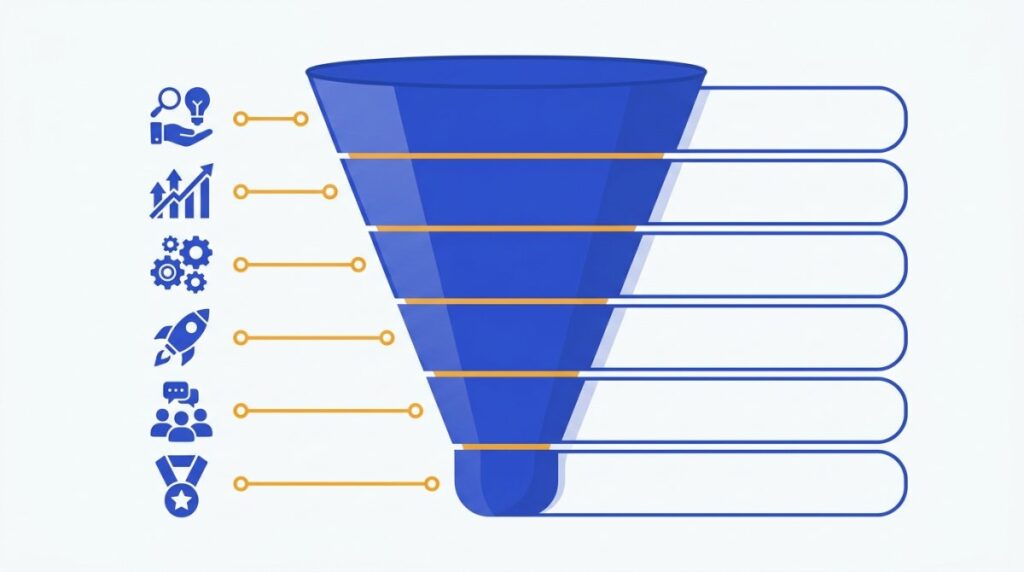
Each of those people types different prompts, and each prompt pulls on different sources. Effective B2B AI search optimization maps a prompt set to every role, then checks whether your company appears, how it is described and which competitors are named alongside you. The table below shows how stages, prompts and content connect.
| Buying stage | Typical AI prompts | Content that earns a mention |
|---|---|---|
| Problem framing | What causes a given operational problem and how companies solve it | Clear explainers with named expert authors and practical frameworks |
| Category exploration | Types of solutions for a need and how they differ | Category guides, approach comparisons and honest trade-offs |
| Long list | Which providers offer a solution for a given industry or region | Accurate service pages, industry pages and consistent directory listings |
| Shortlist | Best vendors for a specific requirement or company size | Best-fit pages, capability statements and third-party mentions |
| Technical validation | Specifications, integrations, standards and security questions | Technical documentation, spec sheets and certification pages |
| Commercial review | Pricing models, contract terms and implementation effort | Transparent pricing model pages, onboarding and process documentation |
🔍 From Our GEO Playbook
For B2B clients, we build the prompt set in a workshop with sales, pre-sales and customer success, not just marketing. The technical and procurement questions that come up in late-stage calls are usually the ones AI engines answer poorly for your category. Publishing precise answers to those questions is one of the fastest ways to become the source AI assistants quote during validation.
What Content B2B AI Search Optimization Services Create
B2B AI search optimization services create content that answers shortlist, comparison and validation questions with precision. The priority is not more blog posts, but pages that let an AI engine state clearly what you do, for whom, how and with what proof.
- Best-fit and use-case pages that say which company types, sizes and situations you serve best.
- Comparison content covering approaches and alternatives, written fairly enough to be trusted.
- Technical documentation such as specifications, integration notes, standards compliance and implementation steps.
- Capability statements for procurement, covering certifications, security practices, quality processes and service levels.
- Pricing model explanations that describe how you charge, even if you do not publish figures.
For a detailed breakdown of each workstream, from crawler access to reporting, see our guide to what is included in AI SEO services.
Want to see which vendors AI assistants shortlist in your category today, and where you appear? We will run the baseline.
How to Prove Expertise When You Cannot Share Case Studies
You can prove expertise without case studies by publishing verifiable, specific evidence that does not depend on naming clients. Many B2B companies work under confidentiality agreements, and AI engines can still recognize authority when the proof is concrete and consistent.
Strong alternatives include certifications and accreditations, industry standards you comply with, detailed methodology and process pages, product or service specifications, named experts with real credentials, contributions to trade publications, speaking at industry events and memberships in professional bodies. Each of these can be confirmed by a third party, which is exactly what makes it useful to an AI engine.
Consistency matters as much as content. The same certifications, capabilities and descriptions should appear on your site, in structured data, on industry directories and in partner listings, so that AI systems see one coherent entity rather than conflicting fragments.
🔍 From Our GEO Playbook
When a client cannot publish case studies, we often turn anonymized delivery knowledge into process content: how a typical implementation runs, which risks appear at each stage and how they are handled. That kind of page answers the exact validation questions committees ask AI assistants, and it demonstrates hands-on experience without exposing any client.
How AI Visibility Feeds Sales Enablement and Pipeline
AI visibility feeds pipeline by making sure prospects arrive already informed and correctly informed. When the answers they saw during research match what your sales team says, first calls move faster and fewer deals stall over basic misunderstandings.
To connect the two, share the prompt set and monitoring results with sales, and turn recurring AI answers into enablement material: short briefs that explain how AI assistants describe your category, which competitors they mention and how to position against them. Track AI referral traffic in GA4 and tag those leads in your CRM so you can follow them through the full cycle.
If you are budgeting for this kind of program, our guide to GEO pricing explains the models and cost drivers you will meet.
🔍 From Our GEO Playbook
Add one question to your discovery call script: “Did you use an AI assistant while researching vendors, and what did it tell you?” The answers show you, in the buyer’s own words, what the AI engines are saying about you and your competitors. Over a quarter, those notes become a free, continuous audit of your B2B AI visibility.
Ready to align AI visibility with your sales cycle and buying committee? Send us a short brief and we will scope it.

Frequently Asked Questions
How is AI search optimization different for B2B companies?
B2B AI search optimization has to serve several decision-makers across a long buying cycle. Instead of one audience and one purchase moment, it maps prompts to technical, financial, procurement and executive roles. It also relies more heavily on verifiable proof such as specifications, certifications and documentation. The goal is to be shortlisted and described accurately, not just mentioned.
Which AI platforms matter most for B2B buyers?
It depends on your audience and region, which is why a baseline audit should test several platforms. Many business buyers use ChatGPT, Microsoft Copilot, Perplexity, Gemini and Google’s AI features in search. Copilot can be especially relevant where companies work inside Microsoft tools. Ask your sales team which tools prospects mention to prioritize testing.
Can AI search optimization help with long sales cycles?
Yes. Long cycles involve repeated research by different people at different stages, and each stage creates new prompts. Visibility at the long-list and shortlist stages keeps you in consideration, while precise technical and commercial content supports validation later. Tracking AI referral leads through your CRM shows how that visibility contributes over the full cycle.
What if our competitors dominate AI answers in our category?
Start by identifying the sources AI engines cite when they recommend those competitors. Often they are directories, comparison articles, trade media or review platforms where you are missing or described poorly. Improving your presence in those sources, while publishing clearer best-fit and technical content on your own site, is usually the most effective route. Expect this to take sustained effort rather than a single fix.
Do we need to publish prices for AI search optimization to work?
No. Many B2B companies cannot publish fixed prices, and AI engines can still describe you accurately. What helps is explaining how you charge, what drives cost and what a typical engagement includes. That gives AI assistants something reliable to say when buyers ask about commercial terms, instead of guessing or leaving you out.