Table of Contents
Most bad hires in AI search can be spotted before the contract is signed, because a weak AI SEO company usually gives itself away in the pitch: it promises outcomes nobody controls, skips measurement and keeps its methods and your assets out of reach. Knowing the warning signs protects your budget, your brand and months of lost time.
We have been part of search projects at AtalosWeb since 2017, and the rise of AI answers has brought a wave of new offers, some excellent and some simply relabeled. The eight red flags below come from reviewing proposals and reports in this space, and each one comes with a green flag you should look for instead.
💡 Key Takeaways
- Walk away from any guarantee of placement in ChatGPT, Google AI Overviews or any other AI answer.
- Require a documented baseline and repeated prompt sampling before the first invoice.
- Ask who owns the content, data, markup and accounts and get the answer in the contract.
- Question any long minimum term that is not tied to a clear, phased plan.

Why Hiring the Wrong AI SEO Company Costs More Than Fees
Hiring the wrong AI SEO company costs you time and position, not just budget. While an agency produces activity that looks busy, competitors can become the default sources AI engines cite for your category, and that advantage is hard to reverse.
The damage can also be reputational. Mass-produced content, manipulative tactics or inaccurate claims about your company can end up in the very sources AI assistants rely on. That is why vetting matters more in AI search than in many other channels, and why our AI SEO and GEO agency services start with transparency on method and measurement.

Promise and Measurement Red Flags to Spot in the Pitch
The first three red flags appear in what the company promises and how it proposes to measure. They are the easiest to catch, because they usually surface in the first call or the first proposal.

Red flag 1: Guaranteed citations or rankings
No AI SEO company can guarantee a mention, citation or position in an AI answer. Responses vary by user, prompt wording, location and model version, and they draw on third-party sources the agency does not control. A guarantee means the agency either misunderstands the channel or plans to report something easy and meaningless.
Red flag 2: No baseline before work starts
Without a baseline audit, there is no way to prove progress. A credible company will test an agreed prompt set across several AI platforms, benchmark you against named competitors and record the sources the engines cited, all before content production begins.
Red flag 3: Screenshot-only reporting
A monthly report built from a few screenshots is anecdote, not measurement. Because AI answers change between runs, each prompt should be sampled repeatedly, with results shown as trends over time alongside AI referral traffic and conversions from GA4.
🔍 From Our GEO Playbook
Ask the company to explain how many times it tests each prompt and on which platforms, and how it handles an answer that changes from one run to the next. A confident, specific answer shows a real measurement process. Hesitation, or a reply about “proprietary tracking,” usually means results will be cherry-picked.
Method Red Flags: Content, Off-Site Work and Black-Box Tools
The next three red flags concern how the work is actually done. They are harder to spot because they hide behind attractive volume numbers or impressive-sounding technology.
Red flag 4: Mass AI-generated content
High volumes of generic AI-written articles are cheap to produce and rarely cited. AI engines tend to favor sources that show clear expertise, specific evidence and named authors. A plan that measures success by the number of posts published is optimizing for the agency’s workflow, not your visibility.
Red flag 5: No off-site plan
AI answers lean heavily on third-party sources such as reviews, directories, trade media, comparison articles and community discussions. A company that only works on your website is doing half the job. Ask for a written plan that names the types of sources it will target and why.
Red flag 6: Black-box tools and secret methods
If the method cannot be explained, it cannot be evaluated. Be wary of proprietary AI engines, hidden-text tactics or anything described as a trick. Legitimate work is explainable: technical access, entity clarity, quotable content, off-site mentions and measurement.
Before you judge any proposal, it helps to know your own starting point. We can show you how AI assistants describe your company today.
Contract Red Flags: Asset Ownership and Long Lock-Ins
The last two red flags sit in the contract, which is where many buyers stop reading closely. They determine how easily you can leave if the relationship does not work.
Red flag 7: The agency keeps your assets
Everything created for you should belong to you: content, structured data, analytics setups, dashboards, profiles and any accounts opened in your name. If the agency holds these, leaving means starting over, which gives it leverage you should not hand over.
Red flag 8: Long lock-in without a clear reason
AI visibility takes time to build, so a minimum term can be reasonable. The red flag is a long commitment with no phased plan behind it. A fair contract explains what happens in each phase, which checkpoints will be reviewed and what your options are if those checkpoints are missed.
🔍 From Our GEO Playbook
Before signing, ask for a one-page handover list: every asset the agency will create, where it will live and whose login controls it. Agencies that plan to hand everything over can write this in minutes. If the request causes friction, you have learned something important about how the relationship would end.
What Green Flags Look Like in an AI SEO Company
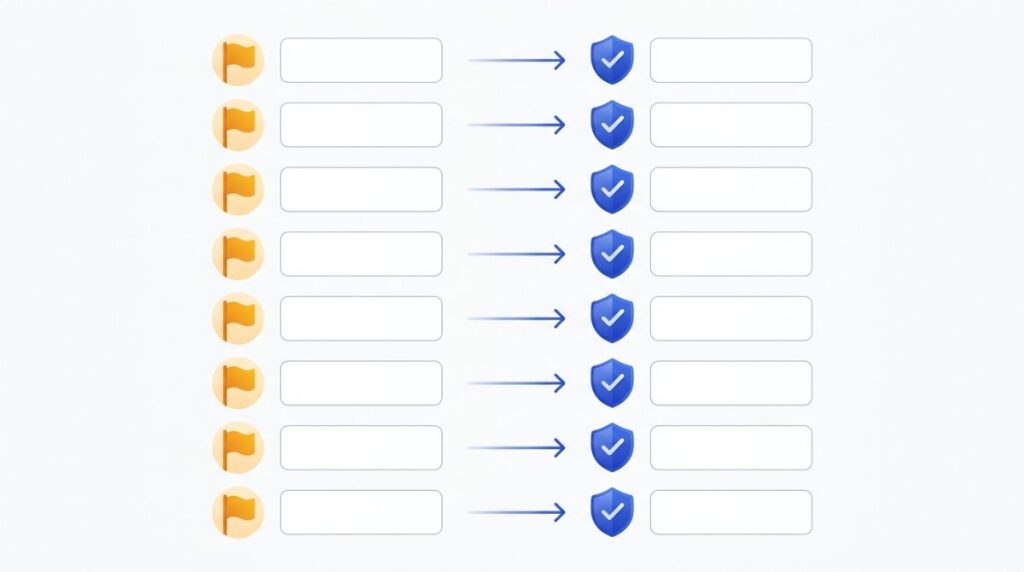
A trustworthy AI SEO company shows specific methods, honest caveats and clear ownership from the first conversation. Use the table below during vendor calls to set each red flag against the green flag you should expect instead.
| Area | Red flag | Green flag |
|---|---|---|
| Promises | Guaranteed citations or rankings in AI answers | Clear goals with honest caveats about variability |
| Baseline | Content starts before any audit | Documented baseline across several AI platforms vs competitors |
| Reporting | A few screenshots each month | Repeated prompt sampling, cited sources, GA4 AI referral data |
| Content | High volume of generic AI-written posts | Fewer, expert-led, answer-first pages with named authors |
| Off-site | “Your website is enough” | Written plan for reviews, directories, trade media and communities |
| Method | Proprietary black-box tools or tricks | Explainable workstreams you can audit |
| Ownership | Agency holds content, data and accounts | You own every asset created for you |
| Contract | Long lock-in with no phased plan | Phased plan with checkpoints and fair exit terms |
🔍 From Our GEO Playbook
One of the clearest green flags is an agency that tells you what it will not do. If a company explains which tactics it avoids, which platforms it deprioritizes for your market and which results depend on factors outside its control, it is showing the kind of judgment you want managing your brand in AI answers.
How to Vet an AI SEO Company Before You Sign
The simplest way to vet an AI SEO company is to turn these red flags into questions and ask every shortlisted provider the same ones. Compare the answers side by side and score them for specificity, honesty and fit.
Ask for a sample report with client details removed, a written scope with named deliverables and a draft contract before you commit. For a fuller question list, see our guide on how to choose a GEO agency; to check whether a proposal’s scope is complete, compare it with what should be included in AI SEO services; and to understand how fees are structured, read our guide to GEO pricing.
Want a proposal that passes every check on this list? Tell us about your company, markets and goals.

Frequently Asked Questions
Can an AI SEO company guarantee results in ChatGPT?
No. ChatGPT and other AI assistants generate answers that vary by user, prompt wording, conversation history and model version, and they draw on sources no agency controls. A company can improve the signals AI systems rely on and measure how often you appear over time. Any guarantee of a specific placement should be treated as a red flag.
How do I check whether an AI SEO company’s reporting is real?
Ask for a sample report and look for prompt-level results tracked over time, not isolated screenshots. The report should show how often each prompt was tested, which platforms were covered, which sources were cited and how you compare with competitors. It should also include AI referral traffic and conversions from GA4. If you cannot trace a number back to a method, question it.
Is AI-generated content always a red flag?
Not always. AI tools can support research, outlines and editing when experienced people guide and review the work. The red flag is mass-produced, generic content published at volume without expertise, evidence or clear authorship. AI engines tend to cite sources that add something original, so quality and specificity matter far more than output volume.
What contract terms should I look for with an AI SEO company?
Look for a written scope with named deliverables, a phased plan with checkpoints and clear ownership of all content, data, markup and accounts. The minimum term should be explained by the plan rather than imposed by default. Exit terms should state what you receive when the relationship ends. If any of this is missing, ask for it before signing.
How long should I give an AI SEO company before judging results?
Give it long enough to complete the baseline, fix foundations and publish the first round of improvements, then judge progress against agreed checkpoints. Technical and entity fixes can show up relatively quickly on platforms that search the live web, while off-site work takes longer. What you should see early is a clear process and transparent reporting, even before visibility moves.